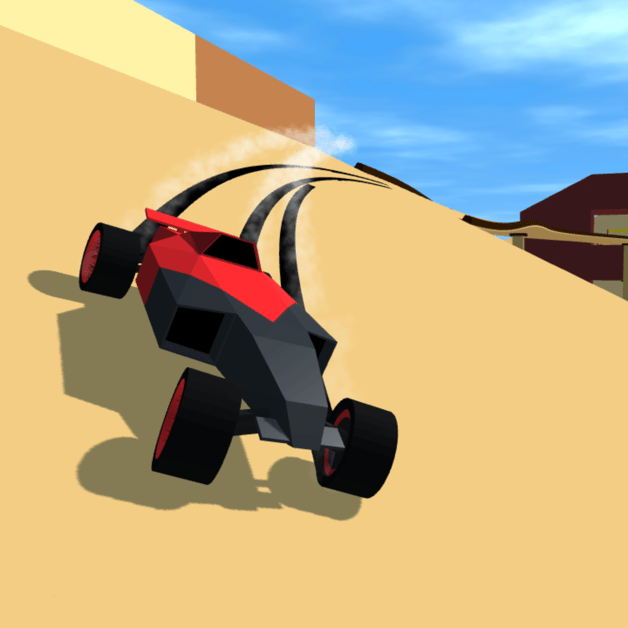
Polytrack Drifting & Advanced Physics: Momentum, Boosts & Air Control
Master advanced driving physics in Polytrack: Scandinavian flicks, air pitch control, surface friction, and boost pad chaining.
FAQ
How do you initiate a high-speed drift in Polytrack?
Why do four-wheel flat landings matter so much in Polytrack?
What is air-braking and when should you use it?
Advanced Vehicle Physics Principles in Polytrack
Polytrack combines arcade responsiveness with an unforgiving 3D momentum physics simulation. Unlike casual racing games where cars automatically snap to the track, Polytrack calculates true weight transfer, tire slip angles, aerodynamic pitch, and rotational inertia.
Mastering these physical forces is what separates bronze-medal casual drivers from top-10 global leaderboard speedrunners.
Straight Velocity ➔ Weight Transfer ➔ Controlled Slide ➔ Boost Chain ➔ Flat 4-Wheel Landing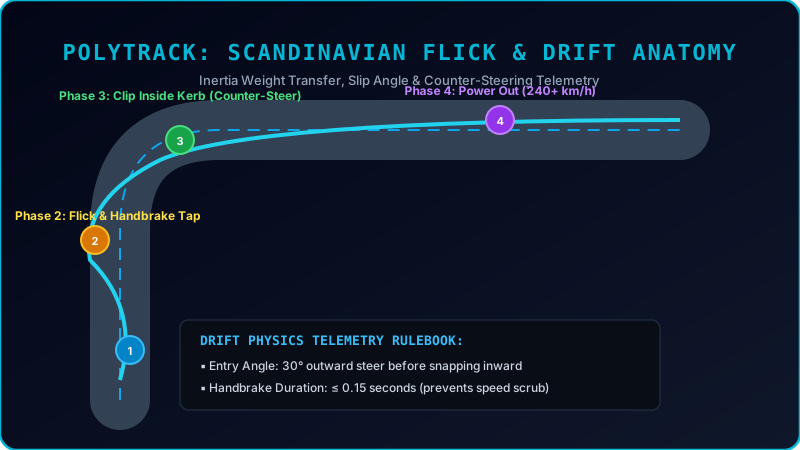
1. The Scandinavian Flick & Controlled Drifting
When attacking tight corners at speeds exceeding 180 km/h, conventional steering causes extreme understeer into the outside guardrail. The Scandinavian flick uses inertia to rotate the car before the turn begins.
Step-by-Step Flick Execution
- Pre-Turn Positioning (Phase 1): Approach the corner from the far outside edge of the asphalt. Maintain full throttle.
- The Counter-Flick (Phase 2): 10 meters before the turn, steer sharply away from the corner for 0.1 seconds, then immediately snap the steering wheel into the corner while tapping the handbrake (
Spacebar). - Counter-Steer Modulation (Phase 3): As the rear wheels break traction, immediately counter-steer in the opposite direction. Keep the accelerator (
W) pinned down—the front-wheel pull prevents the car from spinning out. - Apex Clip & Power Exit (Phase 4): Clip the inside curb kerb and straighten the steering to rocket out of the corner at 220+ km/h.
Review basic input setups in our Beginner Racing & Controls guide.
2. Airborne Pitch, Yaw & Roll Alignment
Custom stunt tracks and official campaign courses feature massive elevation drops and launch ramps. Controlling your low-poly vehicle while in flight is just as important as on asphalt.
In-Flight Hotkey Controls
| In-Flight Action | Keyboard Keybind | Physical Effect on Vehicle | Best In-Game Scenario |
|---|---|---|---|
| Pitch Down (Nose Dive) | W / Up Arrow | Lowers front bumper | Matching downward slope landing ramps |
| Pitch Up (Nose Rise) | S / Down Arrow | Raises front bumper | Leveling out after steep vertical loop exits |
| Air Roll Left / Right | A / D | Tilts vehicle chassis | Aligning tires with banked 45° wall landings |
| Air-Braking | S (Tap in flight) | Truncates jump trajectory | Avoiding overshooting small landing pads |
The Golden Rule of Flat Landings
Landing on only two wheels forces the physics engine to absorb kinetic energy through one suspension spring, causing a violent bounce that launches the car off-axis. Always tap W or S in flight so all four tires make contact with the asphalt simultaneously.
3. Boost Pad Stacking & Kinetic Conservation
Kinetic boost strips inject instantaneous +60 km/h velocity bursts into your racer. However, turning while on top of a boost strip wastes propulsion sideways.
- Approach Trajectory: Line up your car’s center axis before your front tires touch the boost strip.
- Boost Stacking: When multiple pads are placed in sequence, avoid steering adjustments between pads to stack exit speeds above 380 km/h.
- Gravity Boost Amplification: Hitting boost pads while descending a downhill incline multiplies acceleration due to gravitational pull.
4. Advanced Track Mastery & Speedrun Applications
- Wall-Riding Physics: Learn how centrifugal velocity holds vehicles against 90° vertical walls in Wall-Riding and Air-Braking Mastery.
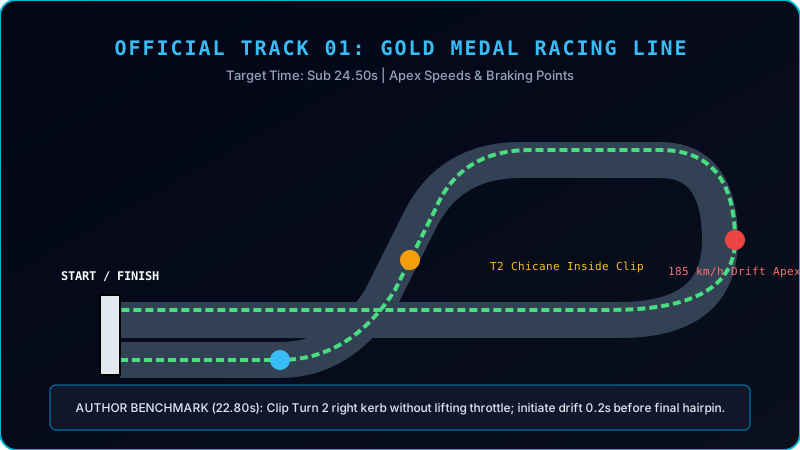
- Official Track Benchmarks: Study turn-by-turn strategies for Official Track 01 Benchmark, Official Track 02 Guide, Official Track 03 Guide, Official Track 04 Guide, Official Track 05 Guide, and the endgame Official Track 06 Guide.
- Verified Track Codes: Test your drift technique on community touge passes in Technical Mountain Drift Codes and Popular Custom Track Codes.
- Telemetry Analysis: Compare your personal best against leaderboard records using Time Attack Telemetry and Ghost Analysis.
- Track Creation: Build your own high-speed drift proving grounds with our Track Editor Complete Guide and Custom Scenery and Lighting Editor Guide.
Related Articles
guides
Polytrack Shortcuts & Speedrun Tips: World Record Lines & Corner Cuts
Master world-record speedrun routes and corner clipping in Polytrack. Learn time-attack lines, jump skips, and apex optimization.
tracks
Polytrack Technical Mountain Drift Codes: Touge & Hairpin Circuits
Instant copy-paste collection of verified technical mountain drift, downhill touge, and hairpin track codes for Polytrack.
guides
Polytrack Time Attack Telemetry: Ghost Analysis & Delta Times
Master competitive time attack in Polytrack. Learn to analyze ghost vehicle telemetry, spot micro-braking errors, and shave milliseconds.
Was this helpful?
Thanks for the feedback!